
DNA FFPE Tissue Kit for DNA Extraction
DNA FFPE Tissue Kit for DNA Extraction
Product Description
This kit employs a safe, non-toxic, and environmentally friendly deparaffinization solution along with an efficient lysis/de-crosslinking reagent, which can lyse and release trace DNA in paraffin embedded sections and tissues. The high-affinity magnetic beads used in the kit can adsorb nucleic acids in a high-salt buffer and release nucleic acids in a low-salt elution buffer, thereby achieving rapid separation and purification of nucleic acids. The obtained products has good integrity and amplifiability, suitable for downstream applications such as PCR, next-generation sequencing, hybridization capture, etc. This kit can be used with automated nucleic acid extraction instrument for high-throughput extraction.
Features
- Safe and non-toxic: Use eco-friendly and non-toxic dewaxing agents instead of traditional toxic xylene for dewaxing
- High yield and quality: The extracted product has a high yield and purity, with no inhibition for downstream applications,
and the extraction effect is stable and reliable.
Mechanism and workflow :
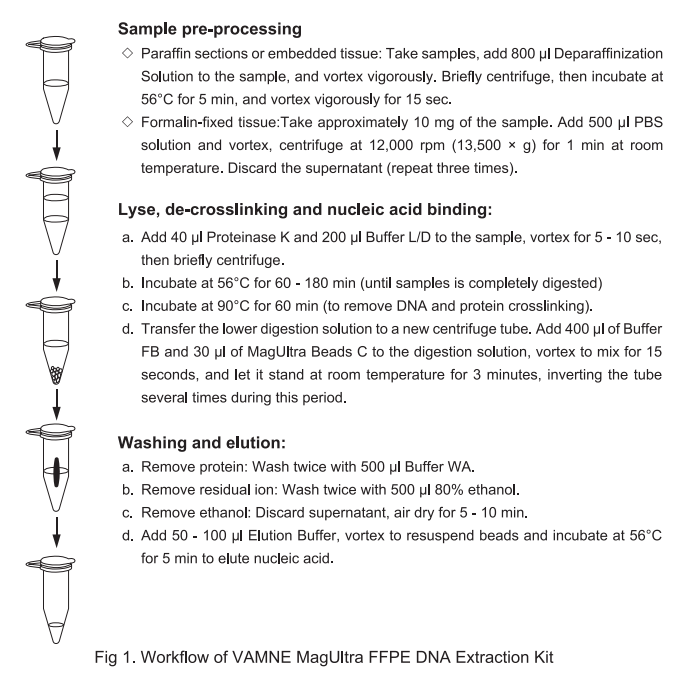
FFPE DNA Extraction Protocol – Magnetic Bead Method
Optimized DNA Extraction from Paraffin-Embedded and Formalin-Fixed Tissues
This optimized FFPE DNA extraction protocol is designed for efficient purification of high-quality genomic DNA from:
- Paraffin sections (FFPE samples)
- Paraffin-embedded tissue blocks
- Formalin-fixed tissues
The method combines deparaffinization, proteinase K digestion, de-crosslinking, and magnetic bead-based nucleic acid purification, ensuring high yield and purity for downstream applications such as PCR, qPCR, NGS, and sequencing analysis.
Step 1 – Sample Pretreatment
A. DNA Extraction from Paraffin Sections
Use 0.5–5 paraffin sections (10 µm thickness, approx. 30 mm² tissue surface).
- Scrape tissue into a 1.5 ml microcentrifuge tube.
- Add 800 µl Deparaffinization Solution.
- Vortex 5 seconds vigorously.
- Incubate at 56°C for 5 minutes.
- Vortex 15 seconds.
- Proceed to lysis and nucleic acid binding.
This step ensures effective paraffin removal for optimal DNA recovery from FFPE tissue.
B. DNA Extraction from Paraffin-Embedded Tissue Blocks
- Scrape approximately 10 mg tissue into a 1.5 ml tube.
- Add 800 µl Deparaffinization Solution.
- Vortex 5 seconds.
- Incubate at 56°C for 5 minutes.
- Vortex 15 seconds.
Continue with the DNA lysis step.
C. DNA Isolation from Formalin-Fixed Tissue
- Cut ~10 mg tissue into small pieces.
- Add 500 µl PBS.
- Centrifuge at 12,000 rpm (13,500 × g) for 1 minute.
- Discard supernatant.
- Repeat washing step three times.
Proceed to lysis and DNA purification.
This process improves DNA extraction efficiency from formalin-fixed samples by removing residual fixatives.
Step 2 – Lysis, De-Crosslinking and Magnetic Bead DNA Binding
- Add 40 µl Proteinase K.
- Add 200 µl L/D Buffer.
- Incubate at 56°C for 60–180 minutes (complete digestion).
- Incubate at 90°C for 60 minutes (reverse formalin cross-linking).
Transfer approximately 220 µl digestion solution into a new tube.
⚠ Important: Avoid transferring the upper deparaffinization layer.
Optional RNA removal:
Add 2 µl RNase A (100 mg/ml), incubate 3–5 minutes at room temperature.
Magnetic Bead DNA Purification
- Add 400 µl FB Buffer.
- Add 300 µl magnetic beads.
- Incubate 3 minutes at room temperature.
- Place on magnetic rack for 2 minutes.
- Discard supernatant.
This ensures strong DNA binding to magnetic beads for high-purity extraction.
Step 3 – Washing and DNA Elution
Washing Steps
- Add 500 µl WA Buffer → magnetic separation → discard supernatant.
- Repeat once.
- Add 500 µl 80% ethanol → magnetic separation → discard.
- Repeat once.
Air dry 5–10 minutes.
DNA Elution
- Add 50–100 µl Elution Buffer.
- Incubate at 55°C for 5 minutes.
- Place on magnetic rack.
- Transfer purified DNA to new tube.
- Store at –20°C.
Applications
Purified DNA is suitable for:
- PCR
- qPCR
- NGS library preparation
- Mutation analysis
- Forensic DNA testing
Recent Posts
-
HyperLadder™ 1kb
MOLECULAR BIOLOGY REAGENT HyperLadder™ 1kb Ready-to-use DNA molecular weight marker for size deter …24th Aug 2026 -
How to Inactivate Proteinase K
How to Inactivate Proteinase K: Complete Guide for Molecular Biology Labs Introduction In molecular …5th May 2026 -
Western Blot System
Western Blot System: Complete Scientific Guide for Protein Detection What Is a Western Blot System? …27th Apr 2026