
RNase Inhibitor Essential RNA Protection for Molecular Biology Applications
RNase Inhibitor
Essential RNA Protection for Molecular Biology Applications
What Is an RNase Inhibitor ?
An RNase inhibitor is a specialized reagent used to block the activity of ribonucleases (RNases), enzymes that degrade RNA. Because RNases are highly stable and present in almost every environment, RNA samples are extremely vulnerable during laboratory workflows.
Using an RNase inhibitor is critical to maintain RNA integrity in applications such as RNA extraction, reverse transcription, and PCR-based analysis.
Why RNase Inhibitor Is Important
RNA degradation is one of the most common problems in molecular biology. Even minimal RNase contamination can rapidly destroy RNA samples.
Benefits of RNase Inhibitor:
- Prevents RNA degradation
- Improves reproducibility of experiments
- Enhances RNA yield and quality
- Essential for sensitive applications like qPCR and RNA sequencing
RNase inhibitor ensures reliable and consistent results in RNA-based workflows.
How RNase Inhibitor Works
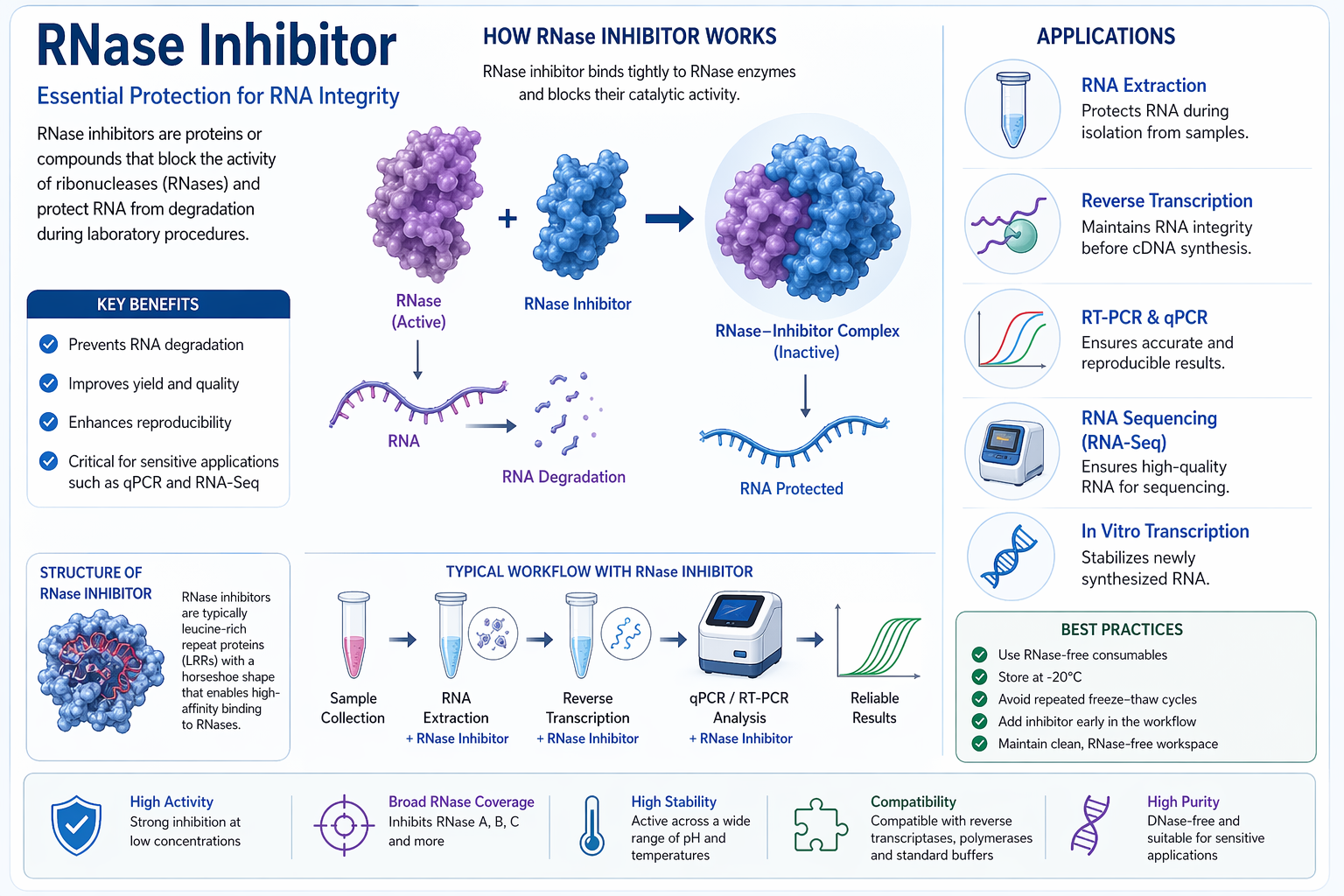
An RNase inhibitor functions by binding tightly to RNase enzymes and blocking their catalytic activity.
Mechanism:
- Forms a strong complex with RNases
- Prevents cleavage of RNA molecules
- Stabilizes RNA during processing
Most RNase inhibitors are recombinant proteins designed for high specificity and strong binding affinity.
Types of RNase Inhibitors
Recombinant RNase Inhibitor
- Protein-based inhibitor
- High specificity for RNase A family
- Commonly used in RT-PCR and cDNA synthesis
Broad-Spectrum RNase Inhibitor
- Targets multiple RNase types
- Provides enhanced RNA protection
- Ideal for sensitive applications
Chemical RNase Inhibitor
- Synthetic compounds
- Used for specialized protocols
Applications of RNase Inhibitor
RNase inhibitor is widely used in molecular biology and biotechnology:
RNA Extraction
Protects RNA during isolation from cells and tissues.
Reverse Transcription (RT)
Maintains RNA integrity before conversion to cDNA.
RT-PCR and qPCR
Improves accuracy in gene expression analysis.
RNA Sequencing (RNA-Seq)
Ensures high-quality RNA for sequencing.
In Vitro Transcription
Stabilizes newly synthesized RNA.
RNase Inhibitor in RT-PCR Workflows
In RT-PCR, RNA must remain intact before reverse transcription. Any degradation leads to incomplete or inaccurate results.
Using an RNase inhibitor:
- Preserves RNA templates
- Increases sensitivity
- Reduces experimental variability
RNase Inhibitor vs RNase-Free Conditions
RNase-free techniques alone are not sufficient to fully protect RNA.
RNase-Free Conditions:
- Clean lab environment
- Sterile consumables
RNase Inhibitor:
- Active protection against RNases
- Works even if contamination occurs
For best results, both approaches should be used together.
Key Features to Look for in an RNase Inhibitor
- High inhibitory activity
- Broad RNase coverage
- Stability across temperature and pH ranges
- Compatibility with enzymes and buffers
- DNase-free and high purity
Best Practices for Using RNase Inhibitor
- Use RNase-free consumables
- Store at -20°C
- Avoid repeated freeze-thaw cycles
- Add inhibitor early in the workflow
Common Mistakes to Avoid
- Not using RNase inhibitor in critical steps
- Improper storage of reagents
- Contamination from gloves or surfaces
- Assuming RNase-free conditions are enough
Conclusion
An RNase inhibitor is an essential component in RNA-based experiments. It protects RNA from degradation, improves reproducibility, and ensures accurate results in molecular biology workflows.
For laboratories and biotech applications, using a high-quality RNase inhibitor is critical for achieving reliable and consistent outcomes .