
PCR Cycler: Complete Guide to Thermal Cyclers for DNA Amplification
PCR Cycler
Complete Guide to Thermal Cyclers for DNA Amplification
What Is a PCR Cycler?
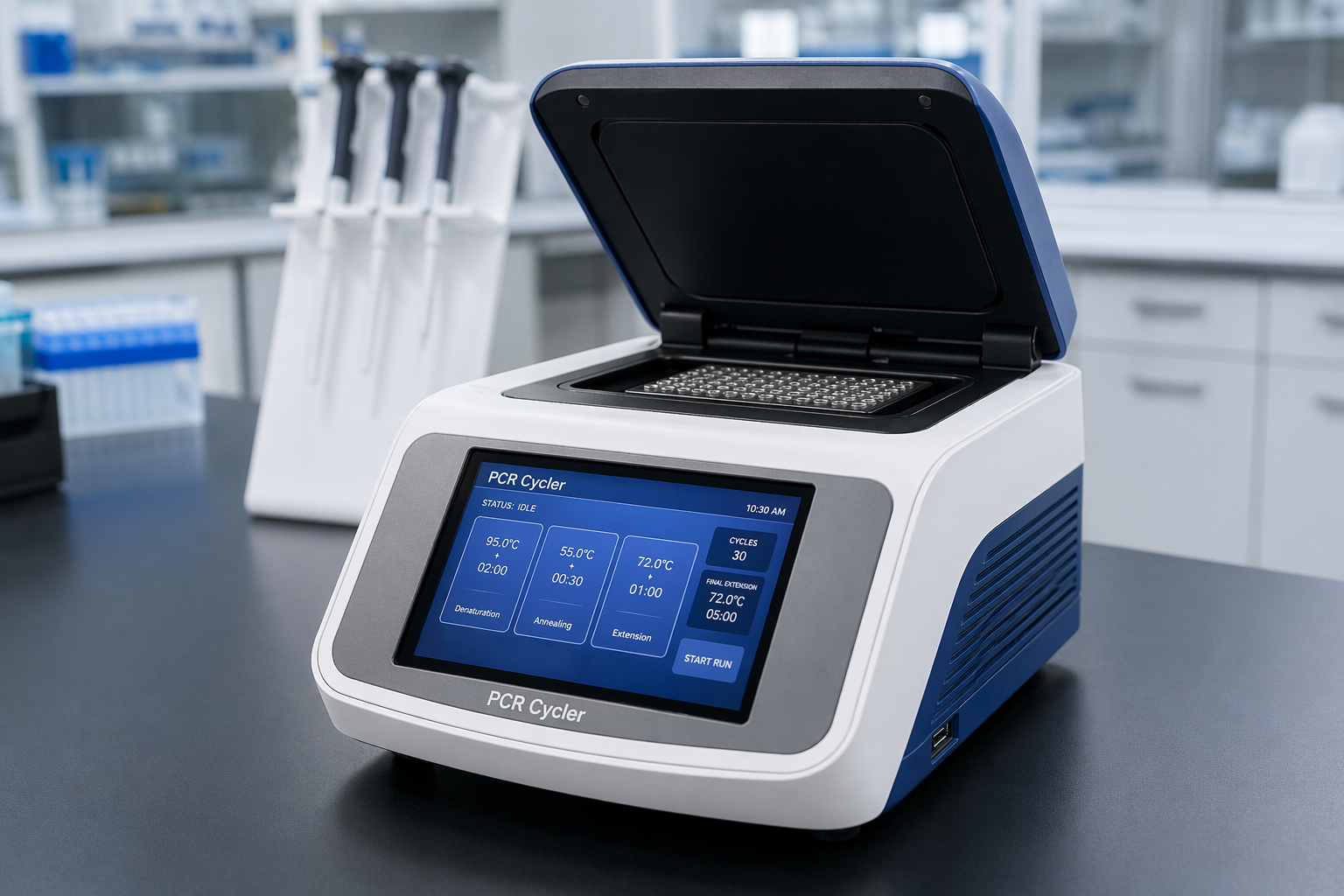
A PCR cycler (also known as a thermal cycler) is a laboratory instrument used to amplify DNA through the Polymerase Chain Reaction (PCR). It precisely controls temperature changes required for DNA denaturation, annealing, and extension.
A PCR cycler is essential in molecular biology, diagnostics, and biotechnology for generating millions of copies of a specific DNA sequence.
How a PCR Cycler Works
A PCR cycler automates repeated temperature cycles to enable DNA amplification.
PCR Cycle Steps:
- Denaturation (94–98°C)
DNA strands separate into single strands - Annealing (50–65°C)
Primers bind to target DNA sequences - Extension (72°C)
DNA polymerase synthesizes new DNA strands
This cycle is repeated 25–40 times, resulting in exponential DNA amplification.
Key Features of a PCR Cycler
Modern PCR cyclers offer advanced features for precision and efficiency:
- Accurate temperature control
- Fast heating and cooling rates
- Uniform temperature distribution
- Programmable cycling protocols
- Gradient capability for optimization
These features ensure reliable and reproducible PCR results.
Types of PCR Cyclers
Standard PCR Cycler
- Basic thermal cycling
- Suitable for routine DNA amplification
Gradient PCR Cycler
- Tests multiple annealing temperatures
- Optimizes primer conditions
Real-Time PCR Cycler (qPCR)
- Monitors DNA amplification in real time
- Used for gene expression analysis
Portable PCR Cycler
- Compact and lightweight
- Ideal for field or mobile labs
Applications of PCR Cycler
A PCR cycler is widely used across scientific and medical fields:
Molecular Biology Research
DNA cloning, sequencing, and analysis
Clinical Diagnostics
Detection of infectious diseases and genetic disorders
Forensic Science
DNA fingerprinting and identification
Biotechnology
Genetic engineering and recombinant DNA work
Food Safety Testing
Detection of pathogens and contaminants
PCR Cycler in Real-Time PCR (qPCR)
Advanced PCR cyclers are used in real-time PCR to monitor DNA amplification as it occurs.
Benefits:
- Quantitative analysis of DNA
- High sensitivity and specificity
- Faster and more accurate results
Key Parameters to Consider When Buying a PCR Cycler
For eCommerce optimization and buyer intent:
Temperature Accuracy
Ensures precise DNA amplification
Block Capacity
Number of samples processed per run
Ramp Speed
Faster cycling reduces experiment time
User Interface
Touchscreen and easy programming
Compatibility
Supports various PCR tubes and plates
Advantages of Using a PCR Cycler
- High sensitivity in DNA detection
- Rapid amplification process
- Reproducible and reliable results
- Automation reduces human error
Best Practices for Using a PCR Cycler
- Use high-quality reagents
- Optimize primer design
- Avoid contamination
- Calibrate the instrument regularly
- Use proper sealing of tubes or plates
Common Mistakes to Avoid
- Incorrect annealing temperature
- Poor primer design
- Contamination of samples
- Using degraded DNA templates
Conclusion
A PCR cycler is a fundamental instrument in modern molecular biology. It enables precise and efficient DNA amplification, supporting applications in research, diagnostics, and biotechnology.
Choosing a high-quality PCR cycler ensures accurate results, improved workflow efficiency, and reliable experimental outcomes.