
Enzyme Used in PCR
Enzyme Used in PCR: Complete Scientific Guide to DNA Amplification
What is the Enzyme Used in PCR?
The enzyme used in PCR (Polymerase Chain Reaction) is a DNA polymerase responsible for synthesizing new DNA strands during amplification. The most commonly used enzyme is Taq DNA polymerase, a heat-stable enzyme that can withstand the high temperatures required during PCR cycling.
This enzyme is essential for copying specific DNA sequences exponentially, making PCR one of the most powerful techniques in molecular biology.
Why is a Specialized Enzyme Required in PCR?
PCR involves repeated cycles of high-temperature denaturation (~95°C), which would normally inactivate most enzymes. Therefore, the enzyme used in PCR must be thermostable to remain active throughout the process.
Thermostable DNA polymerases ensure:
- Efficient DNA amplification
- High specificity for target sequences
- Stability across multiple thermal cycles
- Reproducibility in experimental results
Key Enzymes Used in PCR
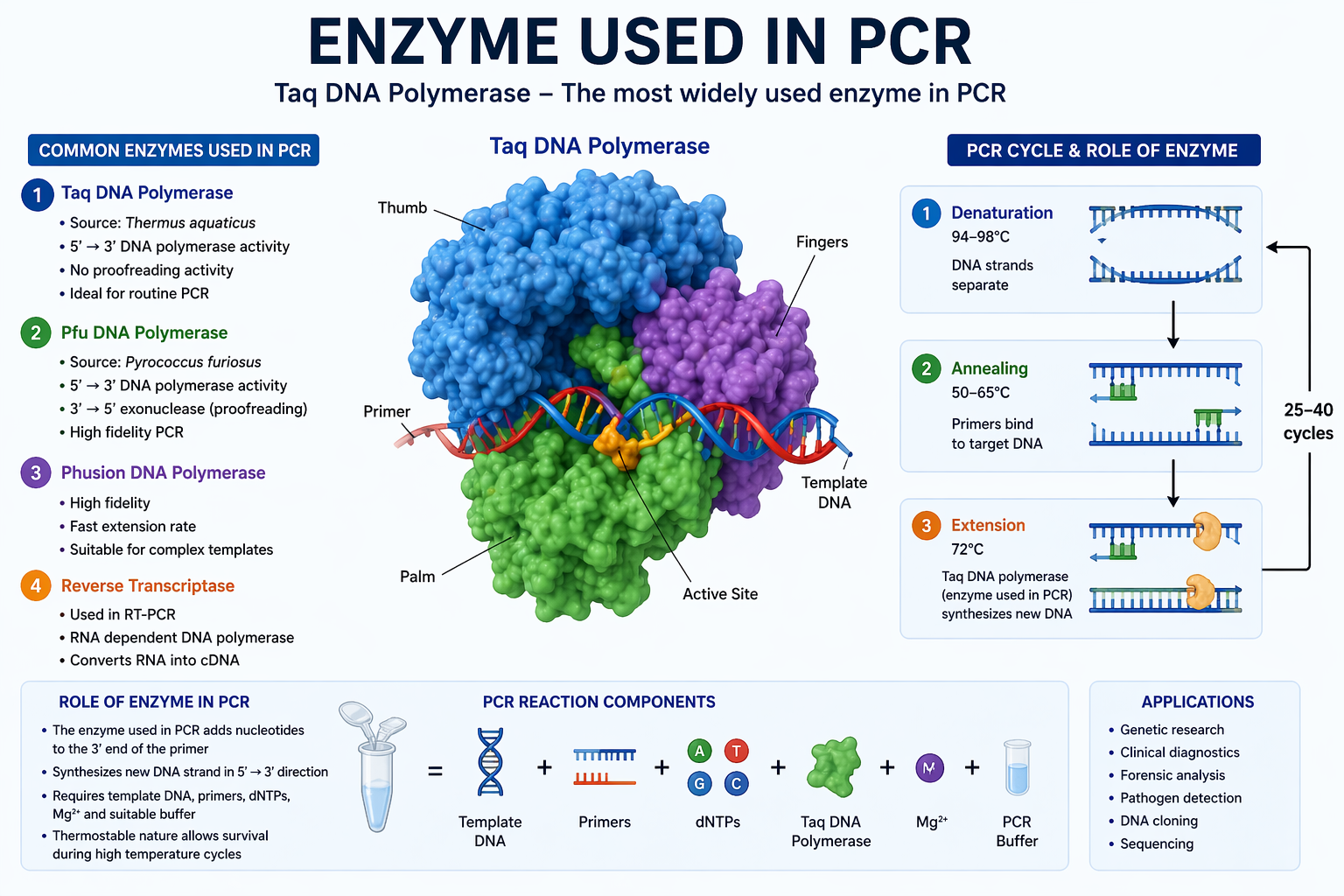
Although Taq DNA polymerase is the most widely known, several enzymes are used depending on the application:
1. Taq DNA polymerase
- Lacks proofreading activity
- Fast and robust
- Ideal for routine PCR
2. Pfu DNA polymerase
- Has 3’→5’ exonuclease activity (proofreading)
- High fidelity DNA synthesis
- Used in cloning and sequencing
3. Phusion DNA polymerase
- Extremely high accuracy
- Faster extension rates
- Suitable for complex templates
4. Reverse transcriptase
- Used in RT-PCR
- Converts RNA into complementary DNA (cDNA)
Mechanism of Action of the Enzyme Used in PCR
The enzyme used in PCR functions during the extension phase of the PCR cycle. After DNA denaturation and primer annealing, the polymerase binds to the DNA template and adds nucleotides to synthesize a complementary strand.
Key characteristics:
- Works in 5’ → 3’ direction
- Requires a DNA template and primers
- Uses dNTPs as building blocks
- Requires Mg²⁺ as a cofactor
PCR Cycle Overview
The enzyme plays a role in each cycle of PCR:
- Denaturation (94–98°C)
DNA strands separate - Annealing (50–65°C)
Primers bind to target DNA - Extension (72°C)
The enzyme used in PCR synthesizes new DNA
This cycle is repeated 25–40 times, leading to exponential amplification.
Factors Affecting Enzyme Performance
Choosing the right enzyme used in PCR depends on several parameters:
- Fidelity requirements (error rate tolerance)
- Amplicon length
- GC content of the template
- Reaction speed
- Buffer composition and Mg²⁺ concentration
Applications of PCR Enzymes
The enzyme used in PCR is critical in:
- Genetic research
- Clinical diagnostics (pathogen detection)
- Forensic analysis
- DNA cloning
- Next-generation sequencing preparation
Common Problems and Solutions
Low Amplification Yield
- Optimize Mg²⁺ concentration
- Increase enzyme amount
Non-specific Amplification
- Use high-fidelity enzymes
- Adjust annealing temperature
Errors in DNA Sequence
- Switch to proofreading polymerases like Pfu DNA polymerase
Conclusion
The enzyme used in PCR is the core component that enables DNA amplification. From Taq DNA polymerase to high-fidelity alternatives, selecting the right enzyme is essential for achieving accurate and reliable results in molecular biology applications.
Recent Posts
-
HyperLadder™ 1kb
MOLECULAR BIOLOGY REAGENT HyperLadder™ 1kb Ready-to-use DNA molecular weight marker for size deter …24th Aug 2026 -
How to Inactivate Proteinase K
How to Inactivate Proteinase K: Complete Guide for Molecular Biology Labs Introduction In molecular …5th May 2026 -
Western Blot System
Western Blot System: Complete Scientific Guide for Protein Detection What Is a Western Blot System? …27th Apr 2026