
RNase Buffer
RNase Buffer: Complete Scientific Guide for RNA Protection and Stability
What Is RNase Buffer?
An RNase buffer is a specialized solution designed to protect RNA molecules from degradation by ribonucleases (RNases), which are highly stable and ubiquitous enzymes that rapidly break down RNA.
Because RNA is extremely sensitive and prone to degradation, using an effective RNase buffer is essential in molecular biology workflows such as RNA extraction, RT-PCR, and sequencing.
Why RNase Buffer Is Essential in RNA Workflows
RNases are present everywhere on skin, lab surfaces, and even in reagents. Without proper protection, RNA samples can degrade within minutes.
An RNase buffer is critical because it:
- Inhibits RNase activity
- Stabilizes RNA structure
- Maintains optimal pH conditions
- Preserves RNA integrity during storage and processing
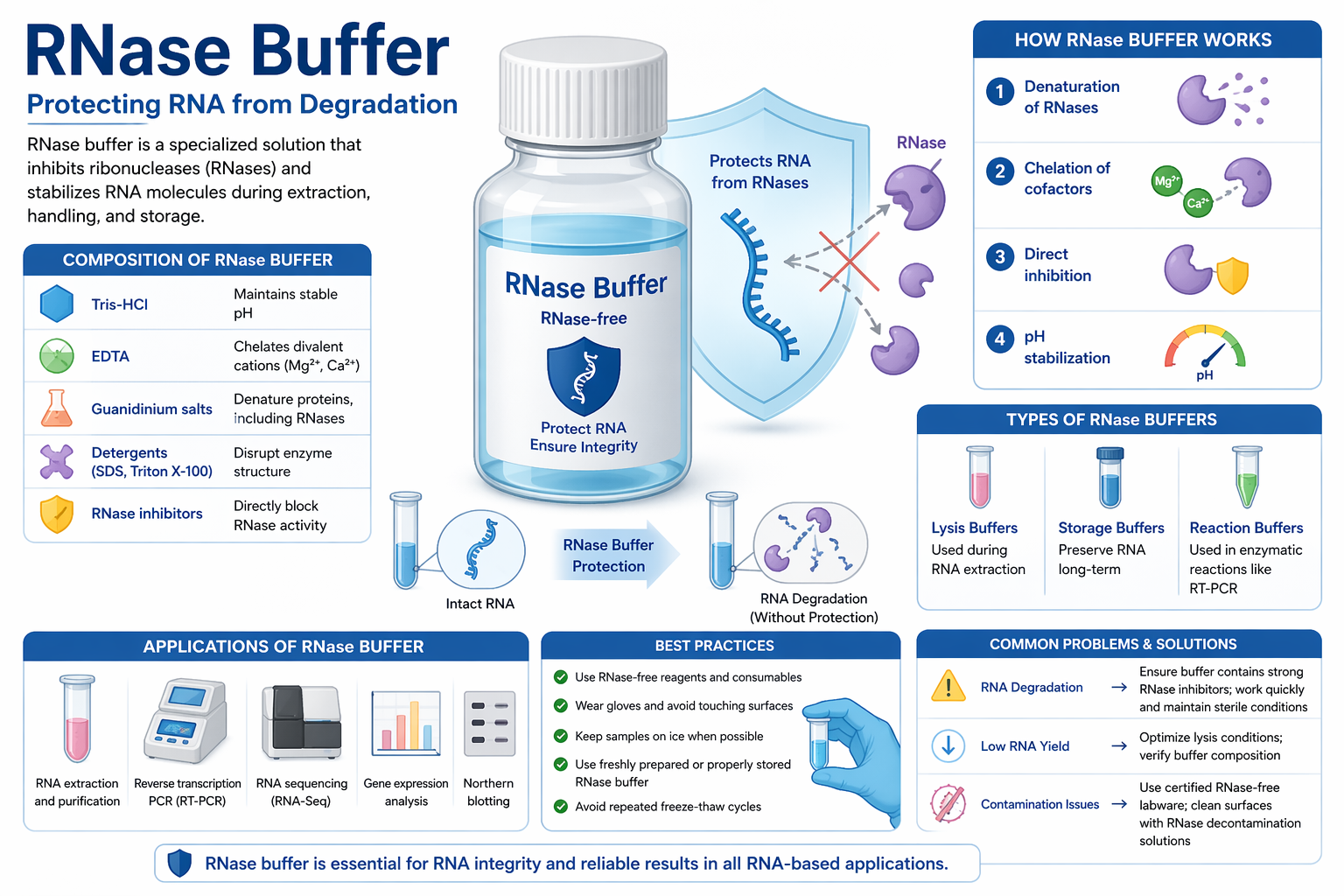
Composition of RNase Buffer
A typical RNase buffer contains components that either inhibit RNases or create conditions unfavorable for their activity.
Common Components:
- Tris-HCl → Maintains stable pH
- EDTA → Chelates divalent cations (Mg²⁺, Ca²⁺) required by RNases
- Guanidinium salts → Denature proteins, including RNases
- Detergents (SDS, Triton X-100) → Disrupt enzyme structure
- RNase inhibitors → Directly block RNase activity
Each component plays a role in ensuring RNA stability.
How RNase Buffer Works
The RNase buffer protects RNA through multiple mechanisms:
- Denaturation of RNases → Chemical agents unfold enzyme structure
- Chelation of cofactors → EDTA removes ions needed for RNase activity
- Direct inhibition → RNase inhibitors bind and inactivate enzymes
- pH stabilization → Maintains optimal environment for RNA integrity
Types of RNase Buffers
Different applications require different formulations of RNase buffer:
1. Lysis Buffers
- Used during RNA extraction
- Contain strong chaotropic agents
- Rapidly inactivate RNases
2. Storage Buffers
- Preserve RNA long-term
- Maintain stable pH and ionic strength
3. Reaction Buffers
- Used in enzymatic reactions like RT-PCR
- Optimized for enzyme activity while minimizing RNase contamination
Applications of RNase Buffer
The RNase buffer is widely used in:
- RNA extraction and purification
- Reverse transcription PCR (RT-PCR)
- RNA sequencing (RNA-Seq)
- Gene expression analysis
- Northern blotting
Best Practices for Using RNase Buffer
To maximize RNA protection:
- Always use RNase-free reagents and consumables
- Wear gloves to avoid contamination
- Keep samples on ice when possible
- Use freshly prepared or properly stored RNase buffer
- Avoid repeated freeze-thaw cycles
Common Problems and Solutions
RNA Degradation
- Ensure buffer contains strong RNase inhibitors
- Work quickly and maintain sterile conditions
Low RNA Yield
- Optimize lysis conditions
- Verify buffer composition
Contamination Issues
- Use certified RNase-free labware
- Clean surfaces with RNase decontamination solutions
Conclusion
The RNase buffer is a critical component in any RNA-based experiment. By inhibiting RNase activity and stabilizing RNA molecules, it ensures reliable and reproducible results in molecular biology applications.
Selecting the right RNase buffer and following best practices can significantly improve RNA integrity and experimental success.
Recent Posts
-
HyperLadder™ 1kb
MOLECULAR BIOLOGY REAGENT HyperLadder™ 1kb Ready-to-use DNA molecular weight marker for size deter …24th Aug 2026 -
How to Inactivate Proteinase K
How to Inactivate Proteinase K: Complete Guide for Molecular Biology Labs Introduction In molecular …5th May 2026 -
Western Blot System
Western Blot System: Complete Scientific Guide for Protein Detection What Is a Western Blot System? …27th Apr 2026