
Oxidase Test
Oxidase Test: Principle, Procedure, Results, and Applications
Introduction to Oxidase Test
The Oxidase Test is a fundamental biochemical test used in microbiology to identify bacteria that produce the enzyme cytochrome c oxidase. This enzyme plays a key role in the electron transport chain, which is essential for aerobic respiration.
The oxidase test is widely used in clinical, environmental, and food microbiology laboratories to differentiate between bacterial species, especially Gram-negative bacteria.
Principle of Oxidase Test
The Oxidase Test is based on the ability of certain bacteria to oxidize a reagent (usually tetramethyl-p-phenylenediamine) into a colored compound.
- The reagent acts as an artificial electron donor
- If cytochrome c oxidase is present, it transfers electrons to oxygen
- This reaction produces a dark purple or blue color
Key idea:
Presence of color = oxidase positive
No color change = oxidase negative
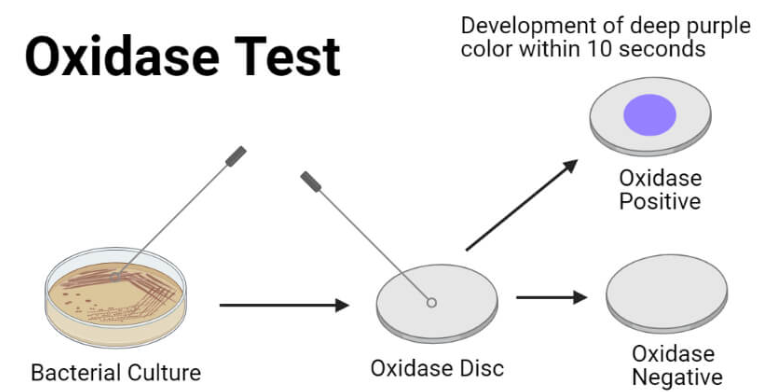
Oxidase Test Reaction
Oxidized reagent → Dark purple color
Reduced reagent → Colorless
The reaction occurs quickly, usually within 10–30 seconds, making it a rapid diagnostic tool.
Materials Required for Oxidase Test
To perform the Oxidase Test, you need:
- Fresh bacterial culture (18–24 hours old)
- Oxidase reagent (tetramethyl-p-phenylenediamine)
- Filter paper or oxidase test strips
- Wooden stick or plastic loop (avoid metal loops)
Procedure of Oxidase Test
Follow these steps carefully:
Method 1: Filter Paper Method
- Place a drop of oxidase reagent on filter paper
- Use a sterile wooden stick to pick a bacterial colony
- Smear the colony onto the reagent-soaked paper
- Observe for color change within 10–30 seconds
Method 2: Direct Plate Method
- Add reagent directly to bacterial colony on agar plate
- Observe immediately for color development
Results Interpretation of Oxidase Test
| Result | Observation | Interpretation |
|---|---|---|
| Positive | Dark purple/blue color | Cytochrome c oxidase present |
| Negative | No color change | Enzyme absent |
Important:
- Read results within 30 seconds
- Late color change may give false positives
Oxidase Positive and Negative Bacteria
Oxidase Positive Bacteria
- Pseudomonas spp.
- Neisseria spp.
- Vibrio spp.
- Campylobacter spp.
Oxidase Negative Bacteria
- Escherichia coli
- Klebsiella spp.
- Salmonella spp.
- Shigella spp.
This makes the Oxidase Test extremely useful in differentiating Enterobacteriaceae (oxidase-negative) from other Gram-negative bacteria.
Applications of Oxidase Test
The Oxidase Test is widely used in:
1. Clinical Microbiology
- Identification of pathogenic bacteria
- Diagnosis of infections
2. Environmental Microbiology
- Detection of bacteria in water and soil
3. Food Microbiology
- Quality control and contamination detection
4. Research Laboratories
- Studying bacterial metabolism and respiration
Advantages of Oxidase Test
- Rapid (results in seconds)
- Simple and inexpensive
- Requires minimal equipment
- Highly useful for bacterial identification
Limitations of Oxidase Test
- Reagent is unstable (must be fresh)
- False positives if read too late
- Some bacteria may give weak reactions
- Requires pure culture for accuracy
Tips for Accurate Oxidase Test Results
- Use fresh cultures
- Avoid using metal loops (can interfere)
- Read results immediately
- Store reagent properly (dark and cold)
Frequently Asked Questions (FAQs)
What is the purpose of Oxidase Test?
The Oxidase Test is used to detect the presence of cytochrome c oxidase enzyme in bacteria.
Why is oxidase test important?
It helps quickly differentiate bacterial species, especially in clinical diagnostics.
What color indicates a positive Oxidase Test?
A dark purple or blue color indicates a positive result.
Can oxidase test be used for Gram-positive bacteria?
Yes, but it is mainly used for identifying Gram-negative bacteria.
Conclusion
The Oxidase Test is a rapid, reliable, and essential tool in microbiology for identifying bacteria based on their respiratory enzymes. Its simplicity and speed make it indispensable in clinical diagnostics, environmental monitoring, and research.
By understanding the principle, procedure, and interpretation, laboratories can efficiently differentiate bacterial species and improve diagnostic accuracy.
Recent Posts
-

What Is Metagenomics?
What Is Metagenomics? Understanding Microbial Communities Through DNA Sequencing 1. Introduction …20th Oct 2026 -
PCR Purification Kit
PCR Purification Kit Principle, Workflow, Applications, and Advantages 1. Introduction Polymeras …20th Oct 2026 -
Amplite® Fluorimetric Proteasome 20S Activity Assay Kit - Green Fluorescence
Amplite® Fluorimetric Proteasome 20S Activity Assay Kit - Green Fluorescence Fluorescent detection …19th Oct 2026