
Cyanine 488NS Succinimidyl Ester: Fluorescent Protein Labeling Reagent
Fluorescent Dyes | Protein Labeling | Bioconjugation
Cyanine 488NS Succinimidyl Ester: Fluorescent Protein Labeling Reagent
A fluorescent cyanine dye for labeling proteins and other molecules containing accessible primary amino groups.
Product Information
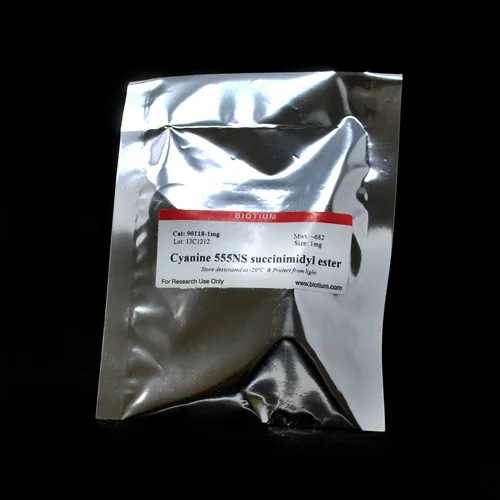
Product name: Cyanine 488NS Succinimidyl Ester
Catalog number: 0037-#90117-1mg
Pack size: 1 × 1 mg
Fluorescence excitation maximum: 483 nm
Fluorescence emission maximum: 508 nm
Molecular weight: 677 Da
Mass added to protein: Approximately 437 Da per labeling event, as listed
Appearance: Orange solid
Solubility: DMF or DMSO
Origin: Synthetic
Shelf life: 12 months, as listed
Dry ice: No
Hazardous: No, as listed
Log in to view pricing and ordering options.
Login for Price24/48H Stock Items & 2 to 6 Weeks non Stock Items.
What Is Cyanine 488NS Succinimidyl Ester?
Cyanine 488NS Succinimidyl Ester is a fluorescent labeling reagent designed for covalent attachment to suitable biomolecules. Its succinimidyl ester reactive group can react with accessible primary amino groups, such as those found on lysine residues in proteins and at protein N-termini, under appropriate labeling conditions.
The cyanine dye provides fluorescence with reported excitation and emission maxima of 483 nm and 508 nm, respectively. These spectral properties make it potentially useful for fluorescence-based experiments using compatible excitation sources and optical detection systems.
Fluorescent labeling enables researchers to track, detect, or visualize labeled molecules in biochemical and molecular biology workflows. The final performance depends on the target molecule, labeling conditions, degree of labeling, and fluorescence detection setup.
Principle of Succinimidyl Ester Labeling
Succinimidyl ester dyes are commonly used to label primary amines through the formation of a stable covalent amide bond. During a typical labeling reaction, the dye is mixed with a suitable protein or other amine-containing target under controlled conditions.
- Prepare the target: Use a compatible buffer that provides suitable conditions for the target molecule and minimizes competing primary amines.
- Prepare the dye: Dissolve the dye in an appropriate anhydrous organic solvent, such as DMF or DMSO, according to the product instructions.
- Perform the labeling reaction: Combine the dye and target under validated conditions to allow the reactive ester to interact with accessible amino groups.
- Remove unreacted dye: Purify the labeled material using an appropriate method, such as desalting, dialysis, or chromatography.
- Evaluate the product: Assess labeling efficiency, fluorescence, and target integrity using suitable analytical methods.
The exact reaction pH, incubation time, dye-to-protein ratio, and purification method should be optimized for the specific application. Avoid assuming that one protocol is suitable for every protein or biomolecule.
Important Handling Note
The product information specifies storage desiccated at −20°C and protection from light. Succinimidyl ester reagents can be sensitive to moisture, so allow the container to reach an appropriate handling temperature before opening to reduce condensation. Follow the current product datasheet for handling and reconstitution instructions.
Key Features
- Fluorescent labeling: Supports fluorescence-based detection of appropriately labeled biomolecules.
- Reactive succinimidyl ester: Designed for conjugation to accessible primary amino groups.
- Visible-range fluorescence: Reported excitation maximum of 483 nm and emission maximum of 508 nm.
- Organic solvent solubility: Listed as soluble in DMF or DMSO.
- Synthetic origin: A chemically synthesized fluorescent reagent.
- Research applications: Potential use in protein labeling, fluorescence assays, and biomolecule detection workflows.
Applications of Cyanine Fluorescent Dyes
- Fluorescent labeling of proteins and antibodies.
- Development of fluorescent biomolecule conjugates.
- Fluorescence-based biochemical assays.
- Detection and tracking of labeled biomolecules in research experiments.
- Fluorescence microscopy and other compatible optical detection methods.
- Research into molecular interactions and biomolecular localization.
Suitability for a particular instrument or assay should be confirmed by matching the dye's spectral properties with the available excitation source, filters, and detector. Performance in a specific application is not guaranteed without validation.
Understanding Excitation and Emission
Fluorescent dyes absorb light at characteristic wavelengths and subsequently emit light at longer wavelengths. The excitation maximum describes the wavelength at which fluorescence excitation is most efficient, while the emission maximum identifies the wavelength at which emitted fluorescence is strongest.
For this product, the reported excitation maximum is 483 nm and the emission maximum is 508 nm. These values can help researchers select compatible optical equipment, although the full excitation and emission spectra should be consulted when designing an experiment.
Technical Specifications
| Product name | Cyanine 488NS Succinimidyl Ester |
| Catalog number | 0037-#90117-1mg |
| Pack size | 1 × 1 mg |
| Excitation maximum | 483 nm |
| Emission maximum | 508 nm |
| Molecular weight | 677 Da |
| Mass added to protein | Approximately 437 Da, as listed |
| Appearance | Orange solid |
| Solubility | DMF or DMSO |
| Storage | Desiccated at −20°C; protect from light |
| Shelf life | 12 months, as listed |
| Origin | Synthetic |
| UNSPSC | 41116105 |
Frequently Asked Questions
What is Cyanine 488NS Succinimidyl Ester used for?
It is a fluorescent labeling reagent intended for covalent conjugation to suitable amine-containing biomolecules, including proteins.
What are its excitation and emission wavelengths?
The listed excitation maximum is 483 nm and the emission maximum is 508 nm. Check the complete spectra when choosing filters and detection equipment.
How should this fluorescent dye be stored?
The supplied product information recommends storage at −20°C in a desiccated environment and protection from light.
Which solvents can be used to dissolve the dye?
The product description lists DMF and DMSO. Use the manufacturer's instructions to determine the appropriate solvent and preparation procedure for your experiment.
Ordering Information
Cyanine 488NS Succinimidyl Ester is supplied in a 1 mg pack for research applications involving fluorescent biomolecule labeling.
Explore Cyanine 488NS Succinimidyl Ester
Find a fluorescent labeling reagent for your protein conjugation and fluorescence research workflows.
Login for PriceFor research use only. Not intended for diagnostic or therapeutic use.
Recent Posts
-
Anti-C5a-R/C5ar1 Antibody Picoband®: Mouse C5a Receptor Detection
Primary Antibodies | Immunology | Complement System Anti-C5a-R/C5ar1 Antibody Picoband®: Mouse C5a …28th Oct 2026 -
Cyanine 488NS Succinimidyl Ester: Fluorescent Protein Labeling Reagent
Fluorescent Dyes | Protein Labeling | Bioconjugation Cyanine 488NS Succinimidyl Ester: Fluorescent …28th Oct 2026 -
MiniSizer 50bp DNA Ladder
Molecular Biology · DNA Electrophoresis MiniSizer 50bp DNA Ladder Ready-to-use DNA size marker for …26th Oct 2026