
Genomic DNA Extraction Kit
Genomic DNA Extraction Kit: A Comprehensive Scientific Overview
Introduction
A genomic DNA extraction kit is a fundamental tool in molecular biology designed to isolate high-quality DNA from a wide variety of biological samples, including blood, tissues, cultured cells, bacteria, and plants. These kits streamline the extraction process, ensuring reproducibility, efficiency, and purity critical parameters for downstream applications such as PCR, sequencing, cloning, and genotyping.
With the rapid expansion of genomics, next-generation sequencing (NGS), and diagnostic technologies, genomic DNA extraction kits have become indispensable in research laboratories, clinical diagnostics, and biotechnology industries.
Principle of Genomic DNA Extraction Kits
Most genomic DNA extraction kits rely on three core biochemical principles:
1. Cell Lysis
The first step involves breaking open cells and nuclei using:
- Detergents (e.g., SDS)
- Enzymes such as Proteinase K
This releases DNA into solution along with proteins, lipids, and other cellular components.
2. DNA Binding and Purification
Modern kits predominantly use silica membrane technology:
- DNA binds selectively to silica in the presence of chaotropic salts
- Contaminants are removed through washing steps
This approach enables rapid purification in less than 15 minutes in many protocols.
3. Elution
Finally, purified DNA is eluted in:
- Water or low-salt buffer
- Typically yielding high molecular weight DNA suitable for molecular applications
Types of Genomic DNA Extraction Kits
1. Spin Column-Based Kits
- Most widely used
- Utilize centrifugation
- Fast and highly reproducible
2. Magnetic Bead-Based Kits
- Ideal for automation and high-throughput workflows
- Common in clinical and industrial labs
3. Salting-Out / Precipitation Kits
- Use salt to precipitate proteins
- DNA recovered via alcohol precipitation
- More traditional but still effective
Key Features of a High-Quality Genomic DNA Extraction Kit
A reliable genomic DNA extraction kit typically offers:
- High purity DNA (A260/A280 ≈ 1.7–2.0)
- High molecular weight DNA (20–50 kb fragments)
- Rapid processing time (15–30 minutes)
- Broad sample compatibility
- Minimal contamination (proteins, RNA, inhibitors)
Some advanced kits also eliminate the need for hazardous chemicals like phenol/chloroform, improving safety and ease of use.
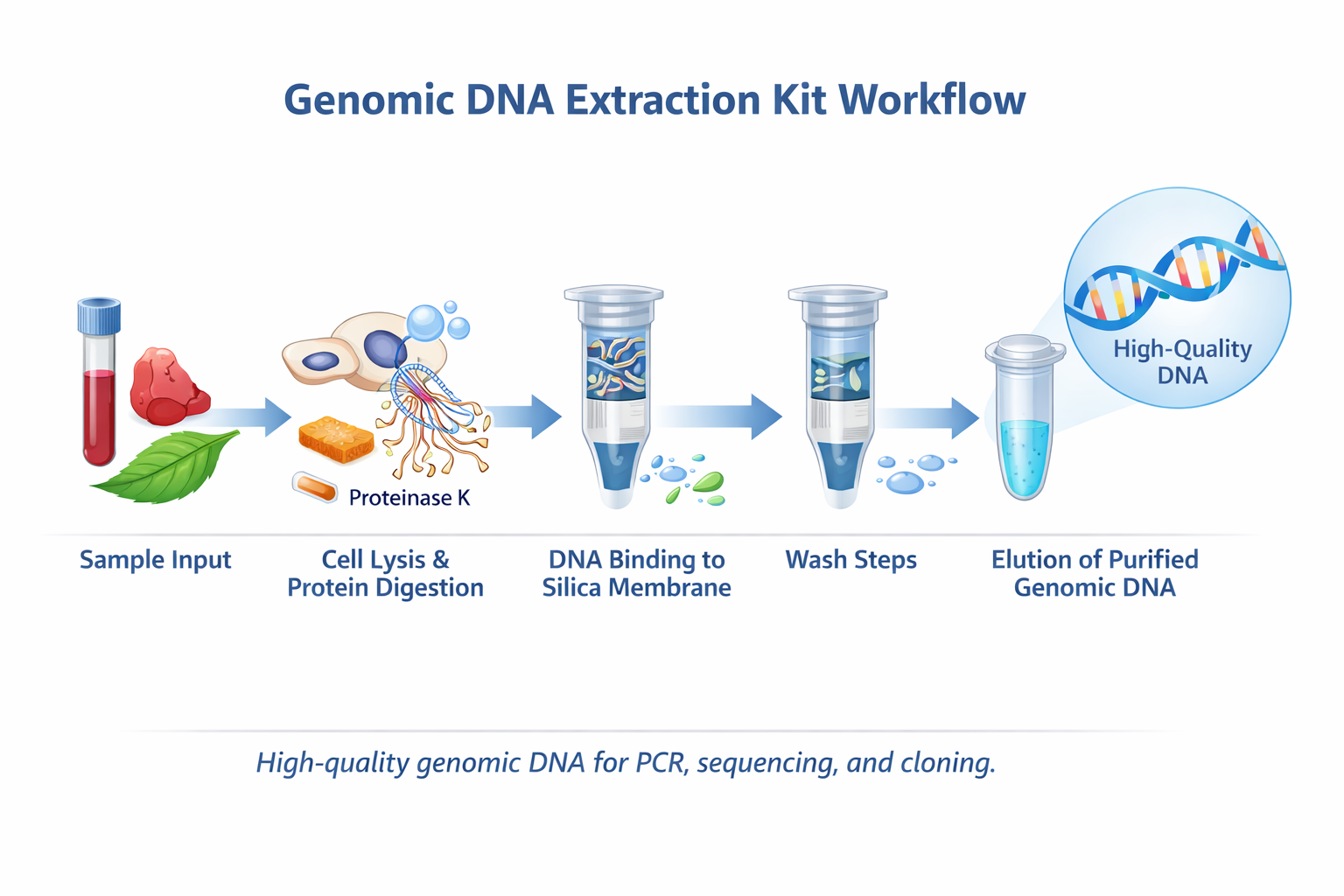
Standard Workflow of a Genomic DNA Extraction Kit
A typical protocol includes:
- Sample preparation (tissue, cells, blood, etc.)
- Cell lysis and protein digestion
- DNA binding to silica membrane or beads
- Washing steps to remove contaminants
- Elution of purified DNA
This simplified workflow ensures consistent DNA isolation across different sample types.
Applications
Genomic DNA extracted using these kits is suitable for:
- Polymerase Chain Reaction (PCR)
- Next-Generation Sequencing (NGS)
- Restriction enzyme digestion
- Cloning and library preparation
- Southern blotting
High-quality DNA is especially critical for NGS, where integrity and purity directly impact sequencing accuracy and efficiency.
Advantages Over Traditional Methods
Compared to classical methods (e.g., CTAB or phenol-chloroform extraction), genomic DNA extraction kits provide:
- Faster processing
- Reduced hands-on time
- Higher reproducibility
- Lower risk of contamination
- Compatibility with automation
However, traditional methods may still be preferred for specific applications requiring ultra-high molecular weight DNA.
Critical Considerations
To achieve optimal results:
- Avoid DNase contamination (use sterile tools and reagents)
- Minimize DNA shearing (avoid excessive vortexing)
- Use appropriate sample input amounts
- Follow recommended wash and elution conditions carefully
Conclusion
A genomic DNA extraction kit is an essential component of modern molecular biology workflows. By combining optimized chemistry with user-friendly protocols, these kits enable efficient isolation of high-quality genomic DNA across diverse sample types. Their versatility, speed, and reliability make them indispensable for applications ranging from routine PCR to advanced genomic sequencing.
Scientific References
- Smith, C., Otto, P., Bitner, R., & Shiels, G. (2006).
A silica membrane-based method for the isolation of genomic DNA from tissues and cultured cells.
Cold Spring Harbor Protocols.
DOI: 10.1101/pdb.prot4097 - Vilanova, S., et al. (2020).
SILEX: a fast and inexpensive high-quality DNA extraction method suitable for multiple sequencing platforms.
Plant Methods, 16, 110.
DOI: 10.1186/s13007-020-00652-y - Whitten, M., et al. (2021).
A new, simple, highly scalable, and efficient protocol for genomic DNA extraction from diverse plant taxa.
Applications in Plant Sciences. - Zhang, J. et al. (2017).
A rapid and cost-effective protocol for plant genomic DNA isolation using silica columns.
Journal of Integrative Agriculture, 16(8), 1682–1688.
Recent Posts
-
How Psychological Stress Worsens Skin Inflammation
How Psychological Stress Worsens Skin Inflammation: The Sympathetic–Eosinophil Axis Explained Introd …23rd Mar 2026 -
Genomic DNA Extraction Kit
Genomic DNA Extraction Kit: A Comprehensive Scientific Overview Introduction A genomic DNA extractio …23rd Mar 2026 -
Mapping Protein–Protein Interactions by Mass Spectrometry
Mapping Protein–Protein Interactions by Mass Spectrometry: A Comprehensive Guide to Modern Interacto …18th Mar 2026